What Are We Talking About When We Talk About Quests?
1. Introduction
Around a month ago, I left the previous stage of my working life behind. For various reasons, I hurriedly wrote a few things at the time. Looking back, though, they were more like complaints dressed up as a discussion of quest design.
I’ve now spent a little time in a new environment. I’m gradually getting used to its particular ways, and some new challenges are approaching.
Before taking those on, I’d like to try writing something in a calmer frame of mind. People have recently kept asking me whether there is any reasonably comprehensive material they can study on quest design. As it happens, I also came across an introduction to combat design by the veteran designer Wushiwan (五十万). So I’d like to make my own clumsy attempt at something similar: an overview of quest design. It should help me sort out my thoughts before the next stage, and give me something to reread for ideas when my head is a mess later on.
I’ll try to make this understandable, though it probably won’t be as light a read as A Murloc’s Concise Handbook of Quest and Narrative Design. If anything is unclear, or you disagree, you’re welcome to talk it over with me.
2. The difficulties and challenges of quest design
Strictly speaking, quest design is constrained from the outset, because so many different elements make up a quest’s flow.
From the player’s perspective, the immediately perceptible elements include plot points and performances; game mechanics and challenges; the gameplay and objectives supplied by other systems; and the layout, routes, and objectives within a level.
Pay closer attention, and players can also feel the quest’s overall pacing, its objectives and steps, its emotional rises and falls, and the design of its various plot points.
How each of these parts works affects the overall experience.
That doesn’t mean a quest designer is a person constrained by everyone else, whose only job is final assembly. At least, ideally, it doesn’t. Quest design still has its own areas of responsibility and concerns. A respected quest designer simply gets involved in the other disciplines’ work earlier, works their view of the current experience into other people’s thinking, and uses that involvement to shape the eventual quest.
I divide the key considerations in that process into two dimensions: form and spirit.
2.1 Form
“Form” is a concept that comes up in preparation for Chinese art-school entrance exams. Broadly speaking, it describes a student’s ability to represent and reproduce an object. Have they accurately expressed its structure, proportions, and perspective? These are the foundations of the whole picture. Under the standards used in those exams, if the form is wrong, it doesn’t much matter how well you paint everything else.
Applied to quest design, this corresponds to the framework: the structure of the experience, the ways the quest conveys its narrative, and its challenges. When designing these three elements, set emotion aside for the moment. Think only about the experience of moving through the sequence, and combine the tools available to you.
2.1.1 The structure of the experience
We can divide quest structures into three forms: linear, branching, and networked.
Linear
The linear sequence is the most common structure. Players can clearly sense a beginning and an end. They see an explicit objective, go to its location, perform the required interaction, and move to the next task. As the quest advances, they can clearly feel both space and time moving forward.
There are variations on linear quests. Their overall direction remains linear, but they introduce something beyond the monotonous pattern of “go to objective → complete objective → switch objective.”
- Open linear sequences: Provide one or more areas, with an overall route that remains broadly linear. Each area, however, is a relatively open space where players can explore out of sequence to complete its objectives.
- Area-based linear sequences: Almost the reverse of the above. There are still multiple areas, but the route to each is unrestricted. Before entering, players can approach by various routes and methods, with narrative content introduced through behavior scripts and finite state machines. Once inside, the sequence becomes almost entirely linear and script-controlled. This is common in GTA.
- Failure branches: These are not genuinely branching structures, but a kind of false branch. They usually lead either to wrongdoing that clearly causes quest failure, or to special content that leaves the current sequence unaffected. The design either finds a way to bring the detour back around, or simply declares failure and pulls the player back to a checkpoint or the initial state. This is distinct from the more specific idea of a false branch discussed below.
Branching
A branching quest allows different processes or different outcomes. Players generally expect different responses to their choices. This doesn’t just mean dialogue choices that produce different replies. It means different ways to complete the quest.
Suppose the objective is to capture a camp. You could attack it directly, infiltrate or sneak into it, or establish a special relationship with the faction behind it and gain control that way.
At a branch point, the objective usually needs to be broad enough. “Capture the camp,” as above—or, more broadly, “gain control of the camp.” Only a sufficiently broad objective can allow enough choices to emerge, and with them enough outcomes.
Branching quests also have variations:
- Branches arising from rules: These extend from the world’s rules or from interactions between systems. If the game has reputation, NPC affinity, and the ability to attack NPCs, then possibilities such as “fail by killing the NPC” or “fail by becoming hostile to the NPC’s faction” already exist. The design needs fallbacks for players using those rules to interact in ways the quest did not expect. Decide what their actions will cause, and whether wrongdoing is punished—for example, by preventing further progress or killing the player.
- Branches based on secondary conditions, objectives, or challenges: A secondary objective within a challenge triggers the branch. Keeping every squad member alive during a defense, or changing a particular NPC’s fate, can produce a different outcome. These usually serve as rewards or punishments. Whether they affect later quest sequences depends on the production cost.
- False branches: In the broadest sense, any branch that doesn’t affect the final outcome could be called false. In actual production, the definition is usually narrower. Imagine a sequence with a fixed logic: a route, an order, a set of steps. The quest offers an exploratory detour that lets you gather more information. It doesn’t fundamentally change the process or its result; it changes the density of information you receive. Following only the stated steps gives you less information than taking the longer route. Designs like this often introduce a real branch later to reward players who explored and learned more, letting them trigger a “what-if” ending through an action or dialogue choice. Usually that’s an Easter egg, though some games take it seriously.
Networked
A networked quest is very difficult to design. It has many emergent outcomes and depends heavily on uncertain elements such as AI and interactions between systems. That makes its design problems hard to control. But it isn’t impossible. The complexity chiefly comes from “difficulty estimating how many elements are involved” and “fear of the quest’s scale.” Here is a simple sequence of steps for thinking about it:
- First, a networked quest needs an objective sequence: something that progresses independently. That could be time in the world—day to night, Monday to Friday, six months to a year—or some broader progression, such as regional tension, faction affinity, or even health.
- Next, create major events along that sequence. Who takes part? Where do they stand? What do they do? How does the event affect them? Suppose an army of darkness will attack a village in three days, and seven samurai volunteer to defend it. At minimum, we now have villagers, the army, and the seven samurai. Before and after the event, each has different positions, faction relationships, and actions. During the attack, further behaviors and interactions occur and produce results.
- Once those two foundations are in place, choose where the player enters the sequence and design their route through it. The player’s sequence must connect all the events. That lets them see the whole situation and reach at least a minimum outcome.
- Then consider what the player can interact with along the way, and design the triggers and consequences. In the example above, perhaps they don’t enter the village three days beforehand. Instead, they spot the army nearby early and tell their own faction. Three days later, that faction joins the seven samurai in the defense, producing additional outcomes.
- In principle, those outcomes should not be fixed, staged performances. They should arise naturally through gameplay as the systems interact. The army, for example, should already be able to attack the player and the village. Its attack after three days would be implemented by assigning it a GOAL.
2.1.2 How the quest conveys its narrative
Game narrative is usually an enormous topic. Almost anything can be explained as narrative from one angle or another. In this article, however, we’re mainly discussing what the player experiences between receiving an objective and completing it. That includes performances and gameplay interactions. Both belong in this discussion.
I won’t prescribe which combinations of narrative methods produce which experiences. There are too many possibilities. These methods are tools you can combine according to what you want to express and the emotions you want to create. If the result meets your intentions, there is no inherently “forbidden” combination. I wouldn’t advise turning this into a formula.
Instead, when you experience other works or competing games, analyze which methods they use, what experience they create, what you feel, and which elements catch your attention and contribute to that feeling.
For now, let’s make a rough distinction between interactive narrative and staged narrative.
Interactive narrative
Interactive narrative requires players to participate through abilities the game gives them: their basic 3C capabilities—character, camera, and controls—as well as temporary abilities supplied by a level or system. Many designers reason that interactive narrative must involve interaction, so narrative happens only when players interact with objects in the world. But noticing changes in moving objects, or actively observing the environment, is also a form of interactive narrative. It is particularly good at helping players recognize objectives and build their own list of things to do.
Yes, to an extent, following a quest marker or acting on the CurrentTask panel is also interactive narrative.
I usually break this down further:
- Interactions based on basic 3C: walking, running, jumping, zooming, using the interaction button, and collision.
- Interactions based on the player’s main abilities: attacking or shooting, throwing, and grabbing. This includes player states.
- Interactions based on system abilities: using skills or items.
- Interactions based on abilities within a level: combining abilities learned there, using objects in the environment to perform an action, passing through an area within a time limit, or avoiding particular areas.
- Interactions in screen space: quest-information panels, objective markers, and full-screen UI.
- Interactions framed by penalties on player behavior: not using a particular ability, not walking, running, or jumping, or not looking somewhere.
You might ask why visual attention appears in my explanation but not in that list. Actively turning toward an object and producing an interaction is one kind of narrative design. A static arrangement in a room, unchanged and present only to establish atmosphere or serve the sequence, is another.
The visual interaction I’m discussing is more like a script that runs after If Camera LookAt Entity or LookAt Position. Perhaps the clearest example is Superliminal, which uses optical illusions to convey narrative.
Staged narrative
Players tend to notice staged narrative more strongly than interactive narrative. A performance is usually guaranteed to take place in front of them, or it takes over their controls. Often the player triggers it deliberately, so they also have some expectation of what will happen.
We can divide it into two broad categories according to whether it takes control away from the player.
Performances that take control:
- Cutscenes.
- Dialogue, including dialogue with camera direction.
- Timelines and sequences.
Performances that leave the player in control:
- Static environmental storytelling: arrangements of objects and atmosphere. A good quest designer should have some ability to shape environmental atmosphere. Learn to use lighting, object placement, visual space, and the effects of color, and you can create strong environmental storytelling. This is also a way to stage visual guidance, following the same thinking as guidance in level design. In terms of information conveyed, familiar objects are more effective than unfamiliar ones; objects close to reality are more effective than those without real-world counterparts. In principle, familiar environments create safety and unfamiliar ones create tension or fear. But distorted proportions or uncanny perspective can create tension and fear either way.
- Scripted level performances: Level Sequences.
- Staged areas: Used in Destiny 2 and Cyberpunk 2077, among others. Essentially, these are areas where a performance takes place without requiring player participation. You still need to consider the performers’ positions and the best place for the player to watch; entrances, exits, and trigger timing; and the area’s acoustics, including how sound changes with distance and which sounds are emphasized or reduced.
- Cinematic subtitles and voice-over.
Staged narrative usually occupies the player’s attention. If it also takes over their controls, it creates a fairly long pause. Such pauses can significantly affect the quest’s overall pacing. A large part of quest design is deciding when each narrative element appears, in what form, and with how much weight.
2.1.3 Quest objectives and challenges
Objectives—or challenges—are an important part of a quest’s form. I’ve previously described four stages players move through when facing an environment: perceive the situation → understand the current circumstances → establish an objective → act.
The quest objective provides a clear point of reference as players decide what to do. Should they follow it and continue, explore their surroundings first, or do the opposite and disrupt the narrative?
If following the objective represents 100% attention, a freely exploring player might be giving it only 50–60%. The atmosphere established through environmental storytelling may still hold their sense of the situation; they haven’t broken immersion. The quest objective is simply less attractive than something else, so they choose to complete a goal of their own first.
When players actively work against the objective, disrupt the narrative, or try to interfere with the scripts, they are no longer being drawn along by the quest. Their experience has probably departed from the intended design. None of us wants to see that.
But it isn’t necessarily bad. Perhaps your quest contains another narrative layer, and you deliberately want players to resist the stated objective, explore something deeper, and receive a substantial response for doing so. Then this is exactly what you want.
What’s truly bad is when they lose interest in the experience, switch quests, abandon the quest—or abandon the game.
We can give players explicit objectives requiring their basic or principal abilities:
- Defeat, break, or destroy something.
- Reach a place, arrive at a position, or enter an area.
- Protect a unit, or capture a facility or area.
- Interact with an object.
- Complete a challenge supplied by another system.
We can also create less explicit objectives, using only story, narrative, or atmosphere to give players a purpose or challenge. The point is to anticipate what they might try and provide enough positive feedback.
Goals players set for themselves:
- Keep everyone alive in an encounter.
- Deliberately prevent an event before it occurs, including a combat event.
- Enter an area or meet a condition ahead of time.
- Avoid particular states: being detected, attacked, or injured, and so on.
Goals suggested by the narrative:
- Avoid killing enemies, or take them down nonlethally.
- Avoid damaging certain facilities.
- Avoid using certain mechanisms.
- Use—or don’t use—particular items.
Explicit objectives should fit the expectations players infer from the situation.
For vague or self-directed goals, provide enough feedback for their actions—or put safeguards in place that prevent those actions altogether.
Don’t offer vague objectives while refusing to allow emergent solutions or multiple approaches. That will make players lose interest immediately.
2.2 Spirit
To return to the art-exam analogy, spirit asks whether you’ve captured a work’s essential feeling. In quests, it means designing how the experience feels.
Form has clear frameworks: methods that can be reused, applied, and quantified. Spirit, by comparison, seems rather obscure and subjective. Some designers have their own design language and standards. They excel at particular situations and emotional states. Each time they design, they can imagine their audience’s feelings, then adjust the emotional curve through the elements of form. They keep it within what they consider the most fitting range for the experience and arrive at what, to their eyes, is the ideal result.
That’s what we mean when we say someone has a personal narrative design language. It bears their unmistakable signature.
Suppose, however, that you don’t have that instinctive sensitivity or that ability to analyze and structure emotion. I have a few methods that may give you ideas. They aren’t intended to manufacture a design language for you. They are ways to look more objectively at your script and the elements of form available to you, and consider how to create the spirit of the quest. At minimum, they should help you realize the experience your writer wants to create.
2.2.1 Story
When I receive a quest’s story outline, I usually extract the following:
- The basic elements: who is involved, what happens, and how many phases there are.
- The climax: which part of the outline has the greatest impact?
- The underlying order: how is the story presented? Does it have a clear chronological sequence, or a less definite relationship between phases?
- What stays with me after reading: this is important. If nothing in the outline is memorable, you’ll need to create something that is.
- The work it most resembles: something I’ve seen or heard, preferably a film or a sequence in another game.
If you can answer all those questions, congratulations. You can now create a basic quest sequence following the story’s own logic. If the writer hasn’t supplied everything you need, try the following before moving on:
- If this is a personal story, or strongly associated with one character, look for more usable elements in their characterization: habits, small gestures, distinctive visual symbols, a recurring line.
- If the character is playable, an assist character, or a companion during the sequence, draw on their combat style and combat elements as part of the story experience.
- Failing that, look for elements of the factions and organizations that can become symbols. If events already exist, extract elements from them.
- If the story lacks a climax or conflict, introduce or strengthen a conflict through the main characters’ backgrounds and behavior.
- If no reference comes to mind, look for works that match your first, instinctive impression. Talk this over with the writer. A suitable story usually has some point of reference.
Once you’ve done this work on the story, you can move on.
2.2.2 Narrative structure
Every story has a structure to its telling. Usually, we can turn that structure directly into a quest sequence, keeping the experience close to reading the story. At least that should give us a passing, 60-out-of-100 result.
But unless your writer is particularly good at narrative tricks that operate beyond the text, or has specific requirements for the telling, most stories you receive can be treated as a master account of what objectively happens in time and space.
Why introduce that idea? Because quest design is a way of interpreting a story. Its purpose is to create the best narrative experience possible without abandoning the story’s themes or narrative elements. Every quest designer has their own reading of the story, so there is room to tell it through unconventional means.
That doesn’t mean tampering with the writer’s outline—though, actually, you can do that if you discuss it with them and can ensure that the revised sequence better expresses their intended theme.
What I’m discussing is subtler: using pacing and control of the player’s attention to vary how much detail each scene and point in time receives, reshaping the telling into the rhythm you want.
I’ll discuss how under “The dimensions of quest design” below.
For now, decide on the narrative structure: will you intervene in the structure, or follow the story’s existing one? By the end of this step, you should have identified some key scenes in the quest.
2.2.3 Narrative purpose
With an understanding of the story and its structure, the remaining task is to combine the other elements and establish its overall narrative purpose—or, to use a slightly imperfect word, its theme.
Let’s briefly introduce three common emphases: emotion, logic, and experience.
Narrative with a strong emotional emphasis
Here, emotion is what drives players through the entire quest. There is usually a clear, strongly felt focus of opposition: an individual, a phenomenon, or the whole environment. Which one depends on the feeling you’re trying to create.
That emotion should run throughout the quest, including its scenes and events. Together, these establish the emotional atmosphere.
Suppose I want players to remember a quest as oppressive and long. “Pressure” and “looseness” become my keywords. I might create infrequent interactions that must be prolonged: hold to open, hold to break, or mechanisms requiring combinations of codes. I might favor solitary performances that use the player’s 3C, letting them encounter and experience the environment alone. I might also create several broad objectives that have them pursuing a concept or something unclear. These establish the oppressive, drawn-out tone, and I design the rest of the quest around that theme.
Narrative with a strong emphasis on logic
The aim here is to leave players with a sense of intricate complexity. There are usually two approaches.
One builds on traditional narrative tricks: the double-helix structure of Alan Wake 2, for example, or Her Story‘s use of concealed information.
A frequent mistake is to focus too much on hiding information and too little on finding it. Suppose you smash all the information into pieces, scatter it through the quest without any apparent logic, then wait until the audience is thoroughly confused. You pull out a pen and paper, draw the logic for them, and laugh at how bad they are at this kind of work. That might do wonders for your satisfaction as a designer. I don’t think many people will buy your next game.
Remember that you’re creating a narrative experience. You need to guide thought, let information slip naturally, set red herrings that may pull attention away, and offer a crucial clue toward the real answer just before players get lost. Then guide them and the story toward a natural deduction. Looking back, players can recognize the red herrings and the information you quietly revealed while drawing their attention elsewhere. To achieve this, learn to manage shifts in viewpoint and use the things that can anchor their attention.
The other approach is a ripple narrative built on a complex world, factions, and character relationships. Its complexity comes from how different factions feel about events and about one another. Players experience events developing through those emotional relationships and positions. At the end, they find a way to resolve the conflict or choose a faction. The sense of complexity and logic comes more from scale: players maneuver among the factions and eventually produce an ending.
Narrative with a strong emphasis on experience
This is actually the most common of the three, because you are simply designing a sequence for the player to experience.
The main question is which events and scenes express the experience you want.
In the oppressive, drawn-out example above, many interactions built around the physical handling of objects, supported by strong visual presentation, can create a powerful sense of immersion. With that immersion, you can keep players inside the intended experience throughout.
But one easily missed problem is that a large number of immersive interactions affects the overall pacing. When that pacing becomes too uniform, players break immersion. They no longer willingly use their actions to inhabit the character in the narrative, and you lose your hold on their experience.
3. The dimensions of quest design
Form and spirit are essentially how you establish the quest’s direction in its early stages. Together, they determine its tone, narrative goals, theme, and methods of storytelling.
Once that is done, you need to work out the details of the flow and content. Different people’s experience leads them toward different methods. Every project also has its own production pipeline, which constrains the result.
Personally, I divide the detailed work into objective design, flow design, emotional pacing, memorable moments and attention, and the rather contrary idea of designing against emotional expectations. These don’t really happen in a fixed order. As I follow the story and imagine the sequence, I settle whatever comes to mind first. During review, however, I check that all these elements meet my intentions, especially the emotional pacing. I’ll go into those areas and my methods in some detail.
3.1 Objective design
I touched on objectives earlier, but here’s a more precise definition. Objective design concerns Targets and Steps. In the familiar linear quests of Chinese games, this means all the elements associated with one TaskID or StepID.
3.1.1 Target
Unless there’s a particular reason to do otherwise, a Target should be what the player currently needs to accomplish to advance the quest.
It must fit what players infer from their own experience and the situation the game presents. You can’t trap them in a scene where a particular NPC is absent and give them “talk to that NPC” as an objective. They won’t be able to do it. Naturally, they’ll replace your objective with their own list of goals, and the quest will break immersion.
Players form their own lists from experience and circumstance, so they may act with complete disregard for the current marker. If their inferred list is too far removed from the stated objective, and exploring the current Step shows that none of their own goals can be completed, they’ll grow tired of the goals the quest does offer. That creates the dreaded feeling of working through a checklist.
Quest designers therefore need to consider the goals players may set themselves. Arrange the current Step’s environmental content and information accordingly, closing off some possibilities and supplying others, to bring their attention back toward the intended objective.
Players generally engage with their own goals in these ways:
- Explore: enter an area.
- Observe: use 3C or tools to examine a target, either standing still or moving around it.
- Interact: use their basic controls, system abilities, level abilities, or even abilities supplied by the quest itself.
- Ignore: yes, ignoring is also an interaction. When attention shifts, or something drops off the player’s list, that too is a form of interaction. Designers can use this to hide information that creates suspense.
3.1.2 Step
Since we’re still discussing objective design, Step here has the narrower meaning of the quest step associated with an objective. In the quest system, it exists as a single StepID or TaskID. Think of it as a container for scene information and quest scripts.
In this narrow sense, a Step covers everything from completion of the previous objective until completion of the next. Everything within it must therefore be strongly related to the current objective, including the script logic and quest assets loaded for that Step.
Be careful, then, about referencing assets across Steps, initializing them in an earlier Step, or preloading them. Once you load something early, players may trigger logic belonging to a different Step before they’re meant to. If the entity you create has independent logic, that choice can block quest progression.
From the perspective of brain science, humans can’t truly process multiple tasks simultaneously. But a quest can create the appearance of several threads advancing at once through tricks such as preloading Steps, switching playable characters, differentiating objectives, or leaving behind some assets from the previous Step. This is particularly useful for conveying that a major moment is approaching and everyone is making their own preparations for it.
3.2 Flow design
Having defined the basic elements, Steps and Targets, we can discuss quest flow.
We’ll address pacing separately, so here “flow design” means a group formed by combining Steps and Targets.
The smallest possible group is one Step and one Target. I wouldn’t recommend treating that as a complete sequence, though. Players may encounter interruptions: brief or extended disconnections, death, or switching the quest they track. You need a way to restore their progress. If a single Step contains a whole sequence, its script necessarily has multiple stages. Without a separate checkpoint mechanism, the player may have to repeat the entire thing. That’s not a good experience.
A sequence usually has an overarching goal. It may not exist as an explicit Target, but it gives the player’s actions a purpose throughout.
I divide flow design into two kinds, according to how the goal is presented and how the sequence is structured: linear convergence and nonlinear exploration radiating outward.
3.2.1 Linear convergence
This is probably a familiar form of quest flow.
There is an overarching goal such as “escape the corridor” or “enter the stronghold.” It is usually intuitive enough that even without explicit guidance, you’ll have some idea of what to try.
The essential point is that this overarching goal must describe a clear action or outcome, and the Steps and Targets must be closely connected to achieving it.
For example, the player needs to escape a corridor. An enemy shared across several Steps gives them a reason to flee. The corresponding Targets are guidance points along possible escape routes. Completing them guarantees that the player escapes.
There can be brief branches, but they must all converge on a common result.
This is why linear convergence generally suits tight quest sequences. Players concentrate on the overarching goal and the Targets, complete the challenges, and finish the sequence.
Its disadvantage is also obvious. In terms of routing, it makes relatively little use of the environment. Each completed Target advances the sequence, so players feel themselves moving distinctly forward through space or time. That’s also why this structure gives such a clear sense that time is passing.
Of course, MMOs with automatic pathfinding around 2008–2014 did create linear sequences with very little environmental change, such as visiting each tutorial-village service NPC in order. That wasn’t good design. It was usually a compromise made to introduce more systems. The environment changed very little while the quest tried to keep players in one place and time to expose as many functions as possible. The result was exceptionally dull.
3.2.2 Nonlinear exploration radiating outward
Where there is linear convergence, there is also the possibility of spreading outward nonlinearly.
Here the overarching goal is more open: “investigate the situation in this area,” perhaps, or “find a way out of this place.”
Players can explore freely and look for elements that help achieve that goal. There is no prescribed order, and they don’t necessarily have to interact with every element before they can advance. Believe me, making them do that is garbage design, even when there are only a few elements.
What the quest usually needs to control is the total number of Targets in the environment and how each is presented. Not every Target has to be closely related to the overarching goal. But enough of them must clearly advance the quest to keep players from losing their way.
A simple, blunt approach is to mark every Target necessary for the overarching goal, telling players the minimum they need to do to advance. At the same time, fill the environment with unrelated Targets that attract their interest and enter their personal list: talking NPCs, unusual entities or objects that invite interaction, small staged situations, even particular devices for visual guidance. Since you don’t prescribe an order, players naturally combine these according to their interests and attention. Even after completing the overarching goal, they may finish their own list before moving on.
You can refine that approach by replacing the icons with familiar NPCs or objects performing near the essential Targets. This is strong guidance delivered softly. When players become disoriented, one of the first things they do is look for a familiar NPC nearby, so it can work very well.
This structure visibly makes more use of space, and it places players in a more relaxed rhythm. But because the quest itself isn’t advancing, it can also feel as though time has stopped inside the area. That’s a difficult drawback to avoid.
3.3 Pacing and emotion
We like using words such as rhythm and pulse to describe things with a recognizable pattern. Quest pacing follows the same idea.
In more formal language, pacing means adjusting Targets and Steps across one or more sequences on the basis of the player’s emotional experience.
There are many small elements that can affect it. Emotion doesn’t come only from the elements themselves: players may bring outside feelings into the game and respond in unexpected ways.
There is still a principle to follow. It brings us back to spirit: the story, its narrative structure, and its purpose.
The goal of emotional design is to make the feeling of the whole sequence match the design elements you’ve drawn from that spirit.
In other words, the quest shouldn’t independently produce emotions that conflict with its story, narrative purpose, or structure. Emotional design exists to amplify what the story itself creates.
Expressing that spirit requires you to interpret the story from your own position and establish a context for its telling. A storyteller needs their own reading before they can perform a story. What they perform is their understanding, and the result follows from that understanding.
I can discuss some methods from experience, but these are ways of thinking. The actual design still depends on your audience, your own understanding, and that elusive thing called feel.
3.3.1 Designing objectives and steps
Objectives and steps directly affect players’ emotions.
If you want to make a player angry, add lots of small, immersion-focused interactions to an intensely urgent story. That often works better than deliberately designing a frustrating scene—though honestly, making players angry usually isn’t a good idea.
Put those same interactions into a loose, easygoing story or environment, with a relatively open overarching goal, and players will feel relaxed. They’ll repeatedly form their own lists of things to explore nearby.
That’s how objectives and steps behave in different contexts. Reverse the use of that relationship, and you can make the environment work against its apparent tone: a warm scene becomes uncanny, a tense one becomes funny.
Usually, your understanding of the story and its structure will suggest a flow. If nothing comes to mind, however, you can use a blunt method to create a prototype, then calibrate it through testing:
- List the scenes and elements available to this sequence: interactions, plot scenes, performances, and so on. Rate them by the difficulty of the player’s experience. Usually, an objective way to estimate that difficulty is the average time needed to get through the element.
- Consider the score range you want for this sequence. Its scale depends on how many Steps you plan to include.
- Start assigning elements to each Step. Every Step’s final score should fall within the intended range, but the scores shouldn’t all be identical. Ideally, they fluctuate while gradually rising, following the logic of a flow curve.
- If an element appears in two consecutive Steps, discount its score in the second. Also follow the earlier rule: don’t cram a large number of linear objectives into one Step. That creates problems when restoring progress and makes replaying the sequence tiring.
- Package the result for playtesting or QA. Ask others to score each Step using your chosen range, compare their feedback with your own scores, and adjust.
This can produce a sequence that is reasonably unlikely to go wrong. But it may feel very formulaic, without much of a design voice. To address that, think at a broader level about pacing: slow beats and fast beats.
3.3.2 Slow beats and fast beats
In music, a lower BPM makes rhythmic patterns easier to hear and understand. Listeners can notice how the beats combine and hear details in the sound. Understanding the emotion may require time, thought, analysis, and repeated listening to particular passages.
Higher-BPM music requires more concentrated attention. Without training, you may not even be able to identify its rhythmic patterns or phrases. Its emotional expression can be more immediate: something intense and easy to feel.
We can likewise think of quests in terms of fast and slow beats.
Fast beats usually involve brief, small interactions or a continuous, tightly packed story sequence. Since you can’t literally speed up the game itself, they need plenty of presentation that keeps the player in control. Once control is forcibly taken away, the pressure to operate disappears and the player relaxes. Fast beats create a strong sense of forward motion. Space and time advance quickly through all those small actions.
But fast does not necessarily mean tense. Imagine a character who has just showered and is getting ready to leave home. Their objectives might be: turn on the stereo, brush their teeth to the music, wash their face, check the news on their phone, get cereal and milk from the fridge, pour them into a bowl, eat, and leave. This is a rapid sequence of changing objectives. There may even be small challenges, such as pouring without spilling.
Slow beats usually offer an area to explore and a vague objective, accompanied by staged scenes or light encounters. They don’t demand attention by themselves. They’re like the background music shaping the atmosphere in a horror film: you notice it when it swells or suddenly stops. Slow does not mean free of tension. Think of chase-and-escape sequences where you must hold a button or wait, enter a code, or disable safety devices while something is pursuing you. Those are slow beats, but they amplify the narrative they carry.
Good pacing means thinking about how these beats combine. A sudden slow beat after a string of fast ones might be the relief of a narrow escape. It might also be an abrupt pause at the height of suspense. What matters is how it works with the quest’s spirit to create narrative, and ultimately an experience.
3.4 Memorable moments and points of attention
Here’s a sad fact: players rarely remember your whole quest sequence. Usually, they remember a few kinds of things:
- Peaks in the gameplay sequence and peaks in the story.
- Difficult sections and major confrontations.
- Mechanics you repeatedly teach, or elements the story repeatedly emphasizes.
- Things that made them uncomfortable.
- Scares. Use these carefully.
These become much of what players recall when they think back on the quest.
You can also work backward from this to create their impression of its narrative—what we tend to call its feel. The brain is a remarkable thing. Once something is fixed in memory through intense attention or emotion, players can subjectively forget or overlook less satisfactory parts of the flow.
Some common tricks:
- Create an emotionally charged story moment.
- Create a final objective or combined sequence that produces a powerful sense of achievement.
- Create a sequence that is both emotionally powerful and deeply involving.
- Create a challenge the player learns, adapts to, and struggles with from beginning to end. That could also be a monster whose presence is felt throughout.
Another common trick is deliberately creating discomfort. Be very careful with this. Several elements need to work together so players accept that the discomfort comes from the world’s natural narrative, or from something they must overcome, rather than from bad design.
Souls games, for example, present their hostility as part of the world’s narrative, a characteristic of a region or village, then intensify it slightly in the final boss fight. Repeated encounters and practice teach players where that hostility comes from and how to overcome it. The boss tests that learning. What follows is release: a memory of overcoming the challenge and of having learned for oneself.
There’s also a technique I’m less willing to discuss: designing scares. This doesn’t necessarily mean a jump scare or a frightening scene. It means creating a deceptive narrative.
First, establish an unspoken understanding with the player: interacting with a bonfire lets you sit and recover health; shooting a red barrel makes it explode.
Then introduce elements that feel wrong or unsettling. They might be narrative hints or odd arrangements, such as a wall made of red barrels. Most challenges still honor the understanding. Players still receive positive feedback for those interactions. But the surroundings become stranger: bonfires sit closer to monsters; monsters linger around them; barrels become barriers, paths, or parts of structures.
At the right moment, create the real scare: a monster shaped like a bonfire, a boss room packed with barrels, or a structure made of red barrels that the player must use to cross the level.
Alongside the shock, players look back at everything they encountered and find the traces connecting this moment to what came before. That act of looking back has already created a memory of the sequence and its narrative.
3.5 Designing against emotional expectations
If everything so far describes our shared understanding of narrative in quests, this approach deliberately breaks that understanding and builds a narrative of its own.
To an extent, it uses the player’s understanding of game design itself. The aim is a more unexpected quest narrative.
I’m not encouraging you to become a genius—or lunatic—who overturns every rule. But many distinctive, excellent design voices do come from pushing back against an established method.
Personally, I’d suggest waiting until the quest’s flow and narrative have a reasonably stable framework. Then consider breaking some parts: the placement of Targets, the arrangement of Steps, the design of a section. Try something bolder and more surprising in one or a few short sequences, while keeping the overall narrative intact.
In other words, you can try to break form, but you must respect spirit.
This is particularly useful for planting mysteries, with the emotional payoff often arriving at the reveal. Films and trailers use it extensively. They begin with an apparently ordinary situation, introduce something strange, suddenly create a contrast at a particular narrative moment, then leave the question hanging. The audience wants to know what happened, and therefore wants to watch the film or play the game.
The first OD teaser is an excellent example. P.T. used small environmental changes to create unease and then fear. OD‘s trailer boldly tried unnaturally close shots of faces, apparently illogical lines, and a sudden terrified reaction to create a new kind of what I’d call “storytelling through pupils.” Individually, those elements might barely make us feel anything. Presented together in that trailer’s narrative, they create unease and fear.
4. Building a quest system
Originally, I wanted to devote as much space to this section as to everything above. But at this point, I’m honestly tired of writing. And quest systems differ considerably with the work being done, the project, and the technical foundations available.
Besides, I’m not a designer with an entirely technical background. From a designer’s perspective, I may make a system look both complicated and formulaic, while a client or server programmer who understands quest design may see plenty of places to combine or connect its parts.
So I’ll present my understanding through mind maps. Compared with the ideas and interpretations above, this part is more of a clumsy attempt to enumerate everything. Here goes.
Mind map 1: Other quest components
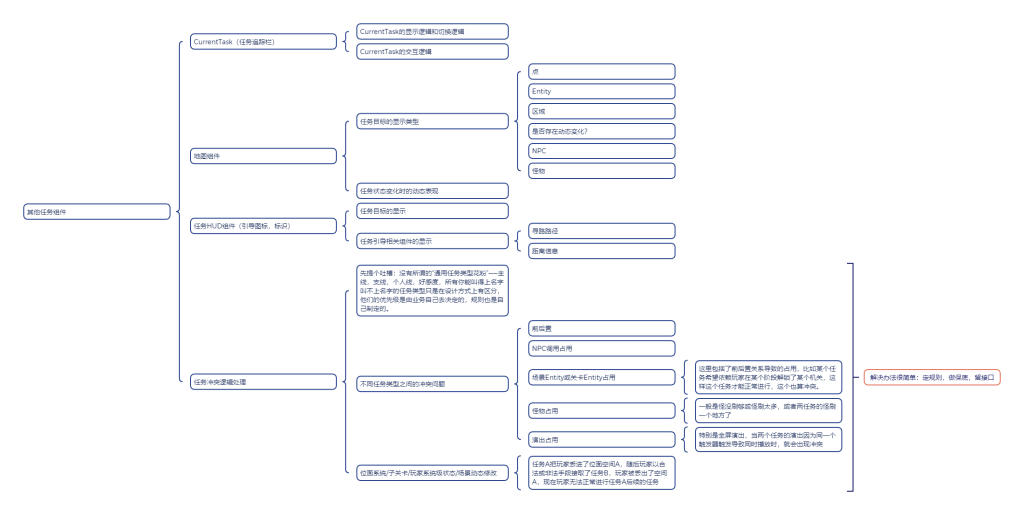
English text of the mind map
- CurrentTask: the quest tracker
- Display logic and switching logic.
- Interaction logic.
- Map components
- Types of objective display: a point, an entity, an area, an NPC, or a monster. Does the display change dynamically?
- Dynamic presentation when the quest’s state changes.
- Quest HUD components: guidance icons and markers
- Displaying objectives.
- Displaying guidance: pathfinding routes and distance information.
- Handling conflicts between quests
- First, a complaint: there is no universal hierarchy of quest types. Main quests, side quests, personal stories, affinity quests—every type you can name or can’t name—differ in how they are designed. Their priorities and rules are decisions made for the project’s particular needs.
- Conflicts between quest types:
- Prerequisite and subsequent quests.
- Competing use of NPCs.
- Competing use of scene or level entities. This includes dependencies: one quest may require a mechanism to have been unlocked during a particular stage of another. That can also cause a conflict.
- Competing use of monsters. Typically, monsters fail to spawn, too many spawn, or two quests spawn their monsters in the same place.
- Competing performances. Full-screen performances are particularly vulnerable: one trigger may start two quests’ performances simultaneously.
- Phasing systems, sublevels, player-system state, and dynamic changes to the scene. For example, quest A sends a player into phase A. The player then accepts quest B by an allowed or unintended means and leaves that space. Now the rest of quest A cannot proceed normally.
- The solution is simple: establish rules, provide fallbacks, and leave interfaces for handling these cases.
Mind map 2: Quest scripts
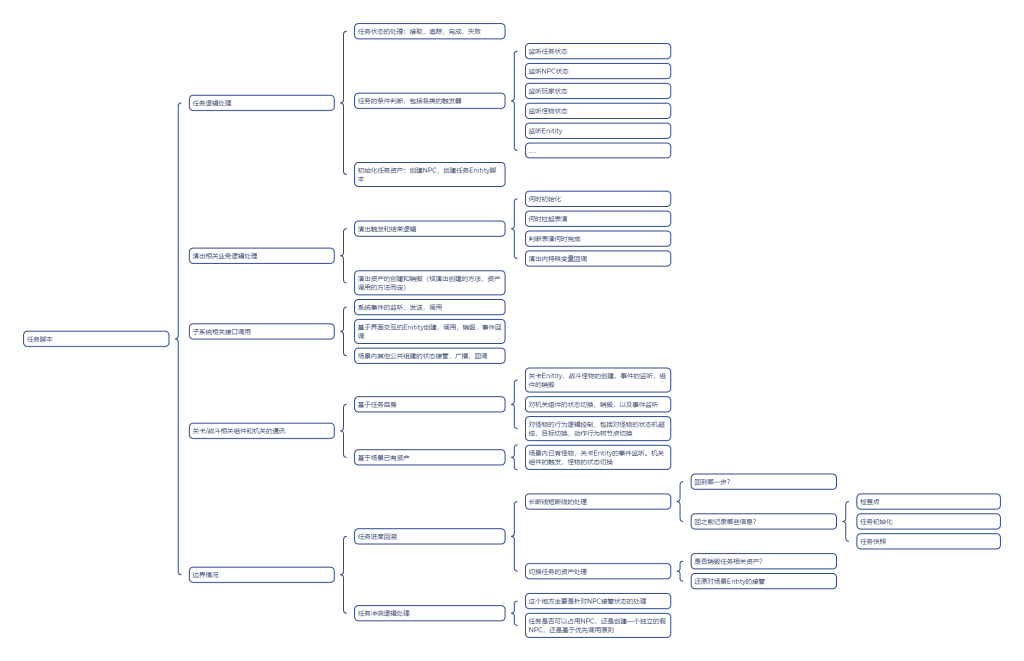
English text of the mind map
- Quest logic
- Handle quest states: accepted, tracked, completed, failed.
- Evaluate quest conditions, including triggers that listen for quest state, NPC state, player state, monster state, entity events, and so on.
- Initialize quest assets: create NPCs and quest-entity scripts.
- Logic associated with performances
- Starting and ending a performance: when to initialize it, when to start playback, how to detect completion, and callbacks for special variables inside the performance.
- Create and destroy performance assets according to how the performance is constructed and how its assets are referenced.
- Calls to subsystem interfaces
- Listen for, send, and invoke system events.
- Create, reference, and destroy entities used in interface interactions; handle event callbacks.
- Take control of other shared components in the scene, broadcast state, and handle callbacks.
- Communication with level and combat components and mechanisms
- For assets belonging to the quest:
- Create level entities and combat monsters, listen for events, and destroy components.
- Change mechanism states, destroy mechanisms, and listen for their events.
- Control monster behavior: override state machines, switch targets, and switch action or behavior-tree nodes.
- For assets already in the scene:
- Listen for events from existing monsters and level entities, trigger mechanisms, and change monster states.
- For assets belonging to the quest:
- Edge cases
- Restoring quest progress:
- Brief and extended disconnections: which step should the player return to? What information must be recorded beforehand? Consider checkpoints, quest initialization, and quest snapshots.
- Asset handling when switching quests: should quest assets be destroyed? Restore control of scene entities that the quest had taken over.
- Conflicts between quests:
- Primarily, handle ownership of NPC control.
- Can a quest reserve an NPC exclusively? Should it create a separate stand-in NPC? Or should access follow priority rules?
- Restoring quest progress:
Mind map 3: Quest logic systems
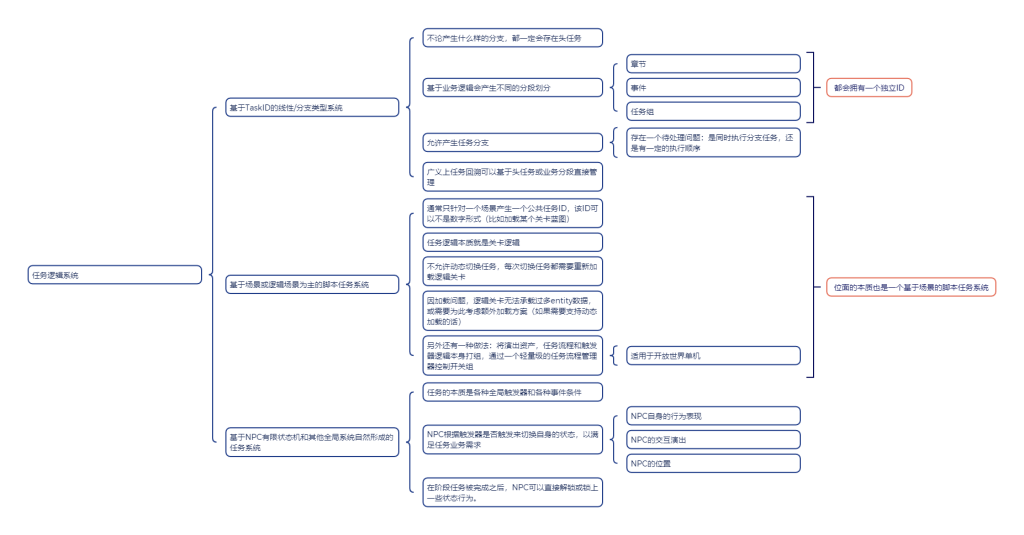
English text of the mind map
- Linear or branching systems based on TaskIDs
- Whatever branches exist, there is always a root quest.
- Divide the content according to the project’s logic: chapters, events, or quest groups. Each has an independent ID.
- Allow branches, while deciding whether they run simultaneously or in a particular order.
- At the broader level, progress restoration can be managed through the root quest or these content divisions.
- Scripted quest systems organized around scenes or logic scenes
- Usually, one scene has a shared quest ID. It need not be numeric: loading a particular Level Blueprint can serve that purpose.
- Quest logic is essentially level logic.
- Quests cannot be switched dynamically; switching requires reloading the logic level.
- Loading constraints limit how much entity data a logic level can carry. Supporting dynamic loading may require a separate loading solution.
- Another approach is to group performance assets, quest flow, and trigger logic, then use a lightweight flow manager to switch groups on and off. This suits single-player open-world games.
- Phasing is, in essence, another scene-based scripted quest system.
- Quest systems emerging from NPC finite state machines and other global systems
- The quest consists of global triggers and event conditions.
- NPCs change state in response to those triggers to meet the quest’s requirements: their behavior, interactive performances, and positions.
- Completing a quest stage can directly enable or disable particular NPC states and behaviors.
Mind map 4: Quest asset management
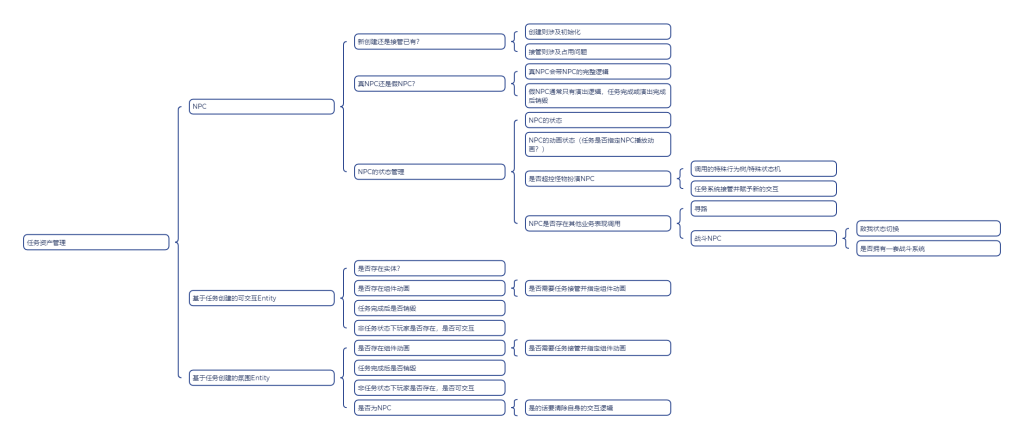
English text of the mind map
- NPCs
- Create a new NPC, or take control of an existing one? Creation requires initialization; taking control raises ownership conflicts.
- A full NPC or a stand-in? A full NPC brings its complete logic. A stand-in normally has only performance logic and is destroyed when the quest or performance ends.
- State management:
- The NPC’s current state.
- Animation state: does the quest prescribe an animation?
- Does the quest override a monster so it can act as an NPC? Which special behavior tree or state machine is used? Does the quest take over and assign new interactions?
- Other functions the NPC needs: pathfinding; or combat behavior, including switching between friendly and hostile states and whether it has a full combat system.
- Interactive entities created by the quest
- Is there a physical entity?
- Are there component animations? Must the quest take control and prescribe them?
- Is the entity destroyed when the quest ends?
- Does it exist in the scene outside the quest, and can it be interacted with then?
- Atmospheric entities created by the quest
- Are there component animations? Must the quest take control and prescribe them?
- Are they destroyed when the quest ends?
- Do they exist outside the quest, and can they be interacted with then?
- Is the entity an NPC? If so, remove its own interaction logic.
Mind map 5: Performance systems
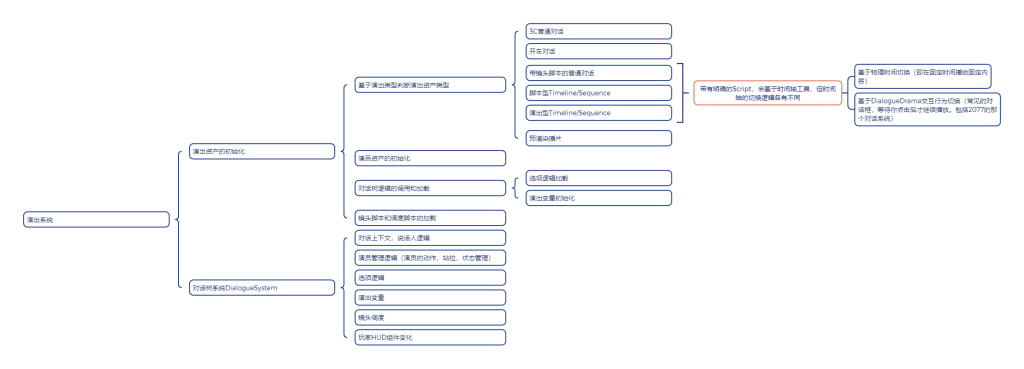
English text of the mind map
- Initializing performance assets
- Determine the assets required by the type of performance:
- Ordinary dialogue using the player’s 3C.
- Dialogue while driving.
- Ordinary dialogue with a camera script.
- A scripted Timeline/Sequence.
- A performance-oriented Timeline/Sequence.
- A prerendered video.
- The camera-script and Timeline/Sequence forms have explicit scripts and use timeline tools, but the logic for advancing along the timeline differs:
- Advancement by elapsed time: fixed content plays at a fixed time.
- Advancement through DialogueDrama interaction: familiar dialogue boxes that wait for a click before continuing, including the dialogue system in Cyberpunk 2077.
- Initialize the actors’ assets.
- Load and invoke dialogue-tree logic: load choice logic and initialize performance variables.
- Load camera scripts and staging scripts.
- Determine the assets required by the type of performance:
- Dialogue tree system: DialogueSystem
- Dialogue context and speaker logic.
- Actor management: actions, positions, and states.
- Choice logic.
- Performance variables.
- Camera direction.
- Changes to the player’s HUD components.