“What Kind of Script Do You Quest Designers Actually Want?” — A Murloc's Concise Handbook of Quest and Narrative Design: An Aside
Really, this is about what we, as quest designers, actually care about in a script.
Reposted from my article on Gcores, so I have a copy on my own blog.
Intro
I should say that I’ve wanted to write about this for a long time.
On the one hand, a year and a half in this job has also meant… a year and a half of hearing quest designers hold the writers responsible for things and complain about them. Especially when I don’t actually think our writers are difficult to work with.
On the other, I have heard a writer complain during a project: “Whatever you hand over to the quest team, they’ll make you change it.”
Quite a few writers, once we’ve gotten to know each other, have asked me the same question: how do you write a story that counts as a “good quest script”?
So, as a former writer and current quest designer (a lowly spreadsheet monkey), I’d like to write a reasonably practical guide to working together, from the quest designer’s side. I also hope it will help my writing colleagues understand which parts of a script a quest designer might be looking at.
Sometimes the problem goes beyond “writing a story” versus “writing a script”
First, any writer who’s been doing this for a while will probably know the classic complaint: someone accuses the script or outline you’ve handed in of reading too much like “a story,” or “a novel.”
Some writers might think, OK, perhaps I’ve made the delivery document too formal. If I write it more briefly, it should be fine.
But the problem may have nothing to do with your prose style or your choice of words. Let’s take a slightly imperfect example.
Wang Miao gently pushed the door open. A faint scent met him, one he had not expected: the scent of a forest. It was as though he had entered a forest ranger’s cabin among the trees. Strips of brown bark covered the walls. The three stools were plain tree stumps, and three larger stumps had been fitted together to make the desk. The bed, too, was evidently laid with wula sedge from the northeast. Everything was rough, casual, without any deliberate attempt at beauty. With Yang Dong’s position, she earned enough to buy a home in any affluent neighborhood. Yet she had always lived here with her mother.
Wang Miao walked up to the tree-stump desk. Its few objects were simple. Nothing suggested academic work, or a woman’s belongings. Perhaps those things had already been taken away. Perhaps they had never been here. The first thing he noticed was a black-and-white photograph in a wooden frame: Yang Dong and her mother. Yang Dong was still a small child, and her mother crouched until they were the same height. A strong wind blew their hair together. The background was strange: a grid covered the sky. Looking closely at the heavy steelwork supporting it, Wang Miao guessed it was a parabolic antenna or something similar, so enormous that its edges lay outside the picture. There was a frightened look in little Yang Dong’s large eyes that made his heart tremble, as though the world beyond the photograph terrified her.
The second thing Wang Miao noticed was a large, thick notebook at one corner of the desk. At first, its material puzzled him. Then he saw a line of childish writing on the cover: “Yang Dong’s Birch-Bark Notebook.” Only then did he realize it was made of birch bark. Time had turned the silvery white bark a dark yellow. He reached out and touched the notebook, hesitated, then withdrew his hand.
Excerpt from Liu Cixin’s The Three-Body Problem, translated here from the Chinese passage quoted in this article; this is not the published English translation.
This is the scene where Wang “Three Waters” Miao first visits Ye Wenjie’s home and enters Yang Dong’s room. (“Three Waters” is the joke in his name: 淼 is made of three 水 characters.)
The prose has that particular narrative quality of Liu Cixin’s. The arrangement works well, too: the viewpoint moves from the whole room into its details, then brings in a few specifics about Yang Dong and Ye Wenjie. The birch-bark notebook touches on Ye Wenjie’s background. A callback.
But what does a quest designer see? Let’s try turning this passage into a sequence for entering the room.

Approach Yang Dong’s door → show a wide view of the room, through the player’s POV or a cutscene → the player enters and the quest objective changes to “Investigate Yang Dong’s room” → provide several objects to interact with; interacting with the birch-bark notebook completes the quest.
You’ll find that, beyond placing a collection of interactive objects in the room, it’s very hard to break this into more quest steps. You might try enriching the sequence by encouraging free exploration. But that also means the player enters without a clear objective to guide them. In other words, they don’t know what they’re supposed to do in there until they interact with the notebook.
It isn’t that games can’t stage a scene the way a film does. When we design a scene like this for a game, we also have to consider interactivity.
So, quite often, the unspoken meaning of “this reads too much like a story” is: it’s hard to design much of a playable sequence from the story you’ve given us.
Sometimes you’ll hear that your characters don’t stand up to scrutiny, or that the story develops in a childish way. That seems strange to you. The script you sent to the quest team was full of changes in the characters’ inner lives. Surely all those microexpressions and subtle touches in the dialogue conveyed their changing emotions? In the end, all you can do is slump angrily in your chair and complain that the quest designer, or the players reading the story, aren’t literate enough.
But here’s the problem: in a game, the ways a character is expressed depend on situations presented from the player’s point of view, with events carrying that expression. In other words: you have to experience it before you can feel it.
If you’ve seen the episode of Gcores’ 银屏系漫游指南 (A Hitchhiker’s Guide to the Screen) called “To Understand Why Game of Thrones’ Ending Fell Apart, We Analyzed 70,000 Characters of Dialogue,” you might remember its argument: to get the story told in six episodes, the writers had to make characters serve the narrative—their functions within it—and dialogue serve the story’s delivery of information.
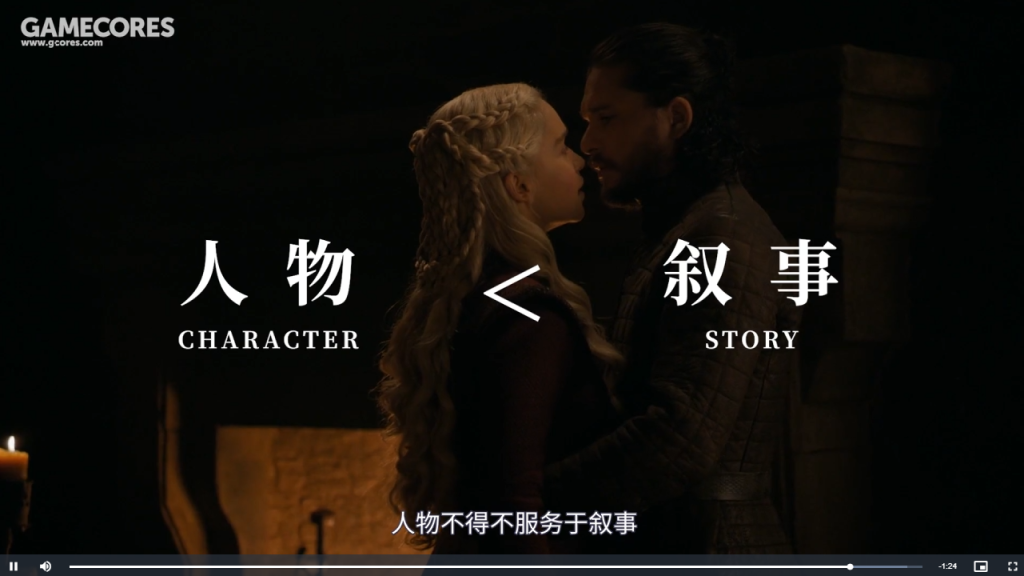
The screenshot puts it as “CHARACTER < STORY”: characters are made to serve the narrative.
When designing a game’s script and story, though, the characters’ logic, emotions, and motivations depend heavily on the events they encounter and what they do within those events. Events can produce playable sequences and interactions. Those, in turn, allow the player to take on a role and become a participant. That is how a game can use interaction and gameplay to express its narrative. The quest’s difficulty, the turns an event takes, even a particular interaction or mechanic can then stir the player’s emotions.
So, unfortunately, what used to count as “bad writing”—events dragging the characters along—becomes a prerequisite for designing quest narrative in a game. And the medium’s limits mean you often can’t reach for the narrative devices you like. You can’t simply design a string of dramatic dialogue scenes and specify every microexpression or gesture. You can’t even assume the player will read every line of the script, or that the actor’s delivery of a line will match what you designed…
In a way, writing for a game is more like writing a sitcom or a stage play that constantly creates new events.
Pacing. Pacing matters.
Once we understand game narrative as a succession of events, another term appears. The one that keeps bothering writers, because those damned quest designers never stop saying it: pacing.
Films and novels have their own pacing, of course. A film’s narrative rhythm may be relaxed at one point and tense at another.
That corresponds to particular kinds of scenes: add a dialogue scene when you want to slow things down, perhaps a fireside conversation, or a relaxing outing.
Novels and articles have their own rhythm, too. Look at this article. Sometimes a paragraph has one or two sentences; sometimes it has a great many. I’m essentially shaping its reading rhythm around my own reading habits.
Games, then, also have their own pacing. We usually talk about a “flow curve.”
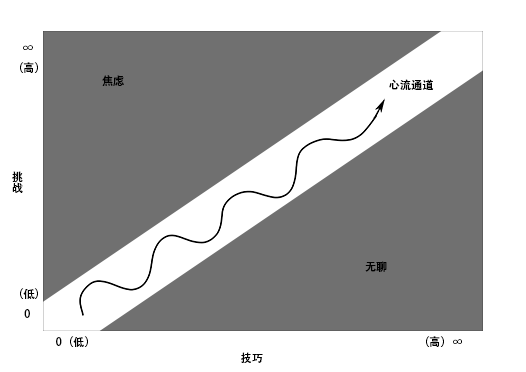
Challenge runs vertically, from low to high; skill runs horizontally, from low to high. Anxiety lies above the diagonal flow channel, boredom below it. The line rises and falls within the channel as it moves upward.
By now, you’re probably… thoroughly sick of this diagram.
In essence, the pacing of a quest needs to fit that flow channel. Quests are part of the game, after all. They have to follow its design principles.
In practice, though, quest design is also influenced by theories of story structure. Personally, I like referring to the “story circle” discussed in 银屏系漫游指南. In my designs, Return and Change usually correspond to the easing and settling of emotion on the flow curve: the aftermath. These are places where I give players, inhabiting their characters, room to release their emotions.
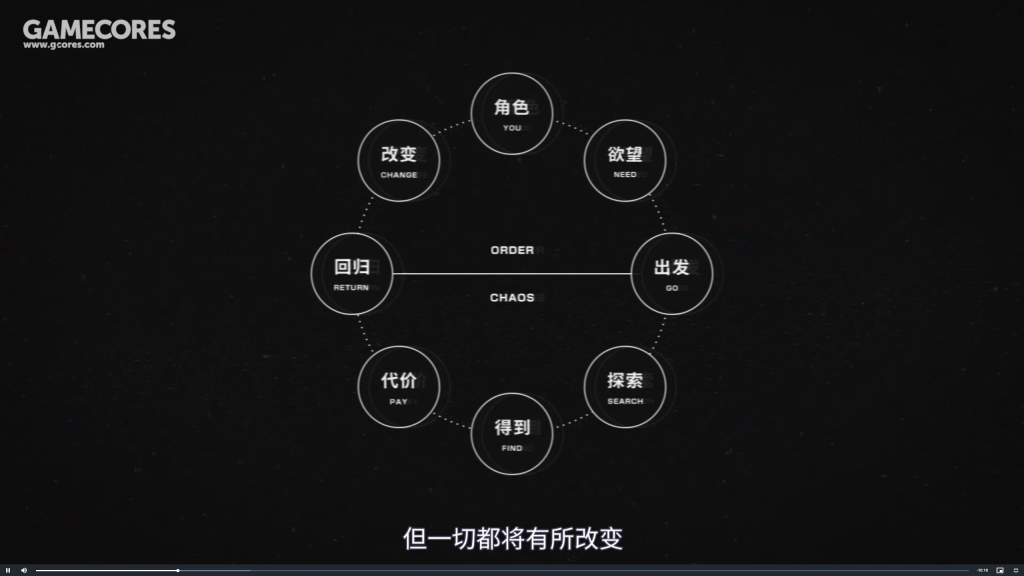
The story circle shown here runs clockwise: You → Need → Go → Search → Find → Pay → Return → Change. Its upper half is Order and its lower half Chaos. The subtitle reads, “But everything will have changed.”
There is one thing I’d like to talk about, though.
Most of the time, on a first playthrough, the player also moves through an emotional cycle like this as they experience that flow:
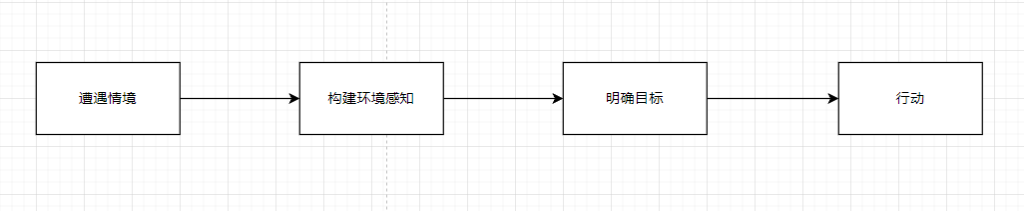
Encounter a situation → build an understanding of the environment → identify the objective → act.
This process of perception is a little like CQB—close-quarters battle. Essentially, you understand the present situation, form an objective, act, and encounter the next situation.
In many CRPGs, and in the sequences of some shooters, a quest begins by dropping the player into an environment. They need to get a feel for it, establish the current objective, and build confidence through action. Then a change disrupts that understanding.
So know what kind of rhythm the scene you’re designing has. When thinking about the story’s pacing, think about the pacing of the experience, too. What phase are the players in? How will they experience it? What can you do with the story at that point? That is what the quest designer actually cares about.
But it isn’t as grim as you might think
Here’s a slightly tangential example.
I vaguely remember it being Quake, or perhaps Unreal Tournament. During an in-person CE test for one of those games, the developers brought in two groups of professional players to test the weapons. For one gun, they secretly changed the sounds between the two groups. Each side heard different firing and reload effects.
Players on one side complained that their gun was much weaker than the opposing side’s weapon. It wasn’t balanced.
But the damage, projectile speed, and firing interval were identical. Only the sound was different…
Games have plenty of ways to express narrative that belong specifically to games. And those ways can cost less than you think.
If I want to establish a powerful enemy in a novel, I might describe the strength of their abilities or the height of their position. If necessary, I might kill a few people to set them up.
Film makes it a little easier, but I’d still need a few hero shots, close-ups of weapons firing, ideally a one-against-a-hundred sequence, lots of rapid cutting, and so on.
In a game, you may only need to introduce them at the right moment with stats and a moveset that are challenging for the player’s current abilities. Think of Isshin Ashina in Sekiro, the Lickers and Tyrants in Resident Evil, the Clickers in The Last of Us, Jeff in Half-Life: Alyx, and so on.
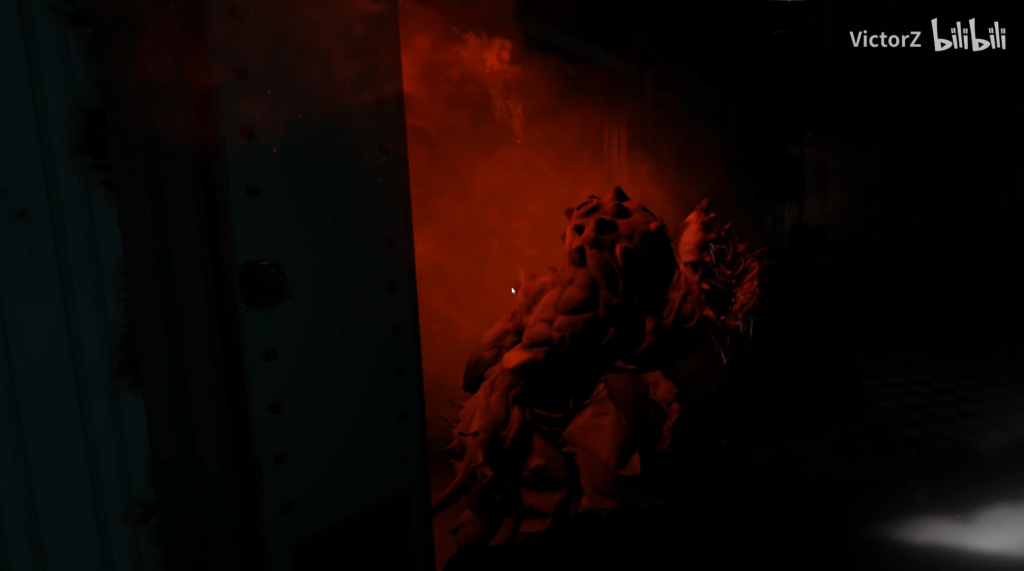
Jeff is a particularly good example of a boss integrated into the narrative experience: the challenge of the level itself, the way he interacts with the player, and how the environment builds him up.
Think back to those bosses. Which of them really relied on the usual film or novel techniques for establishing a powerful enemy? Your impression of them is more likely to come from getting killed on your first encounter, or from a companion’s warning.
Or think back to your whole experience in Ravenholm, the endlessly looping hallway in P.T., or Shepherd’s betrayal in Call of Duty: Modern Warfare 2—the original MW2. How much of what made those levels memorable came from words or camera work? Much more of it came from the situations and environments, right?
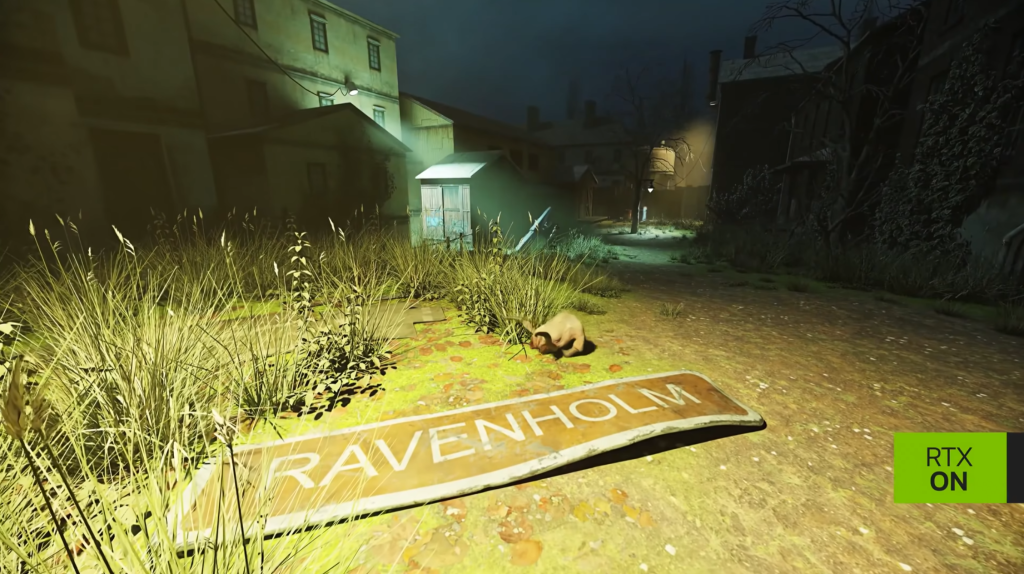
Even the RTX demo chose Ravenholm. Of course it did.
We often call games “the art of interaction.” Or we insist that game narrative is fundamentally a series of designs built around the player’s experience. The “experience” and “interaction” we’re talking about are, in fact, the things we design around the player playing the game.
I do have a complaint here. The design methodology of many Chinese games that call themselves “content-driven” is incredibly cheap: episodic-anime-style scenes + supposedly satisfying combat = we’re a content game. Much of the content comes from the community filling in the gaps in its own head, and from “emotional moments” along the way. We used to ask whether the story made sense. This generation seems to have nothing left but emotional impulses.

The forum comment reproduced above reads:
HoYo’s games don’t have much to offer in gameplay. They rely on polished anime-style models—though things have changed, other companies can make those now, and HoYo doesn’t always seem interested in making good models anyway; look at the perfumer in their other game—plus storytelling that’s like watching an anime. They’re in the business of selling characters.
In gameplay, Honkai: Star Rail is in many ways worse than Fate/Grand Order (FGO). The most irritating thing about FGO is the lack of auto-battle or sweep. Quite a few of its harder fights actually have some design to them, and with regular strengthening quests, you can rotate through different team strategies.
Star Rail’s combat and numerical design is rougher. There are a few team archetypes, but most teams use fixed characters, with very few upgrades or substitutes. The endgame modes depend on the buffs and the characters. Most players have little room to use their brains—or find it difficult to do so. Apart from people who really study it and can keep adjusting their setups, most can only follow pull recommendations. It’s too dull. Then those team strategies quickly become obsolete too.
So Star Rail is really about paying for fun. Have too much of it and you get sick of it. Eventually it becomes a daily launcher for looking after your waifus. Once it can’t produce new waifus, it’s finished.
If HoYo’s stories were consistently excellent and coherent, they could still make very good games. I first played them because they seemed better than watching anime: you could appreciate and control the characters from every angle. But after a while, I found the storytelling far too inconsistent. Even some throwaway isekai light novel is more coherent. And they can’t solve it, because each update needs new characters, so the story serves the characters. Every version’s story inevitably fractures, until it’s so fragmented that it fails as an ensemble story and as an RPG, and can’t become a complete story.
The passage above is the forum commenter’s opinion, quoted in the original article.
Emotional design is, of course, a crucial part of a game’s narrative experience. Good emotional design is also part of taking responsibility for that experience. It’s just that much narrative work in China now conveys emotion through literary qualities, cinematic presentation, or even spin-off promotional videos and fan creations, instead of through game interaction. It really is “Yesterday Once More.” Developers abroad went through their own phase of wanting games to look cinematic and treating that as the path to industrialized production.
Personally, I’d suggest that writers loosen some of the shackles of “traditional art” when designing story scenes. You absolutely can take part in designing the overall gameplay experience of the sequence.
In fact, many colleagues I’ve known are happy to see writers propose gameplay requirements and ideas. Perhaps you want an antagonist who keeps sniping at the player throughout a sequence. Perhaps the final boss fight needs enough pressure to convey the boss’s personality and the feeling that this is a desperate last stand.
To put it jokingly: if Sam Lake can suggest using jump scares in Alan Wake 2 to express “being eroded by the dark forces,” what are you so worried about? Why assume your gameplay ideas will be terrible?
Finally, let’s step back: what makes a quest designer difficult to work with?
I’ll start with a sweeping claim that will probably offend a lot of people: any quest designer who fails to respect a writer’s own expression is failing at their job.
Generally, quest designers have a habit: we don’t directly pass judgment on a colleague’s story.
For me, the heart of quest design is helping someone turn what they express through story into something expressed through experience.
A quest designer is, of course, also a designer with ideas. The job naturally demands that you can at least understand the writer’s script, recognize what it wants to express, and think about how to realize it through game design.
And every creator is free, biased, and inclined to see other people through tinted glasses.
So of course you’ll get quest designers privately complaining that a particular writer’s script isn’t good. Or, afterward, looking back and offering this or that opinion about the script they were given.
But when a quest designer, a professional, sends a writer formal written feedback saying, “Your story is badly written,” “Change this dialogue; even I could write something better,” or “Does this even make sense?”…
That makes me seriously question their professional competence as a quest designer.
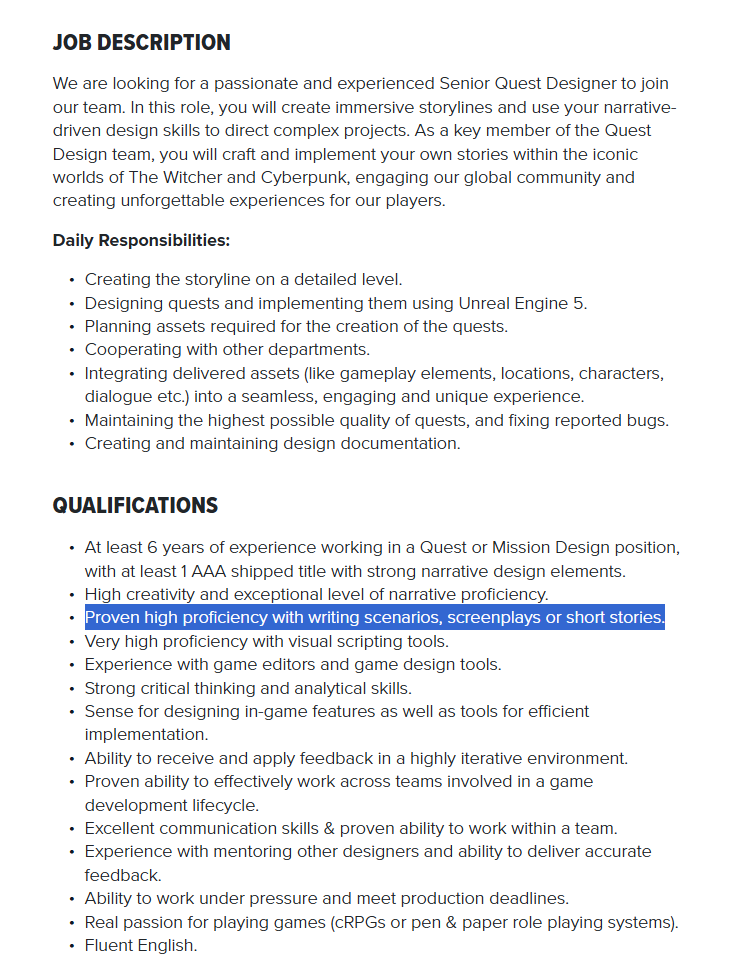
Of course… some studios do expect you to write stories yourself. CDPR, for example. The highlighted requirement in this historical job listing is: “Proven high proficiency with writing scenarios, screenplays or short stories.”
I think we need to distinguish that from the state of “I have an idea.” Sometimes a quest designer really will have ideas about particular story beats, or particular events.
For example, I might say, “This bit could be difficult to convey,” or “The experience here could feel monotonous.” Then I might offer a suggestion: “Let’s expand this one scene into a whole phase of the quest and change the environment as well. We’ll keep its purpose and central idea.”
Provided you’ve actually understood what the writer is expressing and what they’re aiming for, that is a healthy discussion. It’s the kind of “I have an idea” that I advocate. In principle, it respects the writer’s expression. Its purpose is to make the narrative experience fuller, by proposing changes to the sequence and pacing from the quest designer’s perspective.
So you can use that as a test. If the quest designer you’re working with keeps accusing a particular piece of your “plot” or “text” of being wrong, or uses that as the formal reason for rejecting your work, you can regard them as a quest designer who’s difficult to work with.
Because for a quest designer, the story usually sets the baseline score for the sequence. An ordinary story can become a better experience through interesting quest flow and pacing. And when a story already has excellent pacing and has been written together with the gameplay mechanics, even pedestrian quest design will struggle to hide what makes it shine.